Page 1 of 3
Air moving through the horn
Posted: Wed Jun 03, 2026 7:45 pm
by thedancingsousa
Lots of discussion I remember seeing recently surrounding the ideas surrounding air moving through the horn. Standing waves and pedal notes not fitting in small rooms (actually laughed out loud when I read that one) and more. While I'm not here to argue about the idea that moving air is not the primary means of sound production, I did see this video that made me think of the whole conversation, and I chuckled at. Figured I'd share.
https://www.facebook.com/share/r/1H9VWTPFq4/
Re: Air moving through the horn
Posted: Wed Jun 03, 2026 11:13 pm
by bloke
One way to get shouted down (most anywhere) is to state the obvious.
Re: Air moving through the horn
Posted: Thu Jun 04, 2026 4:58 am
by humBell
bloke wrote: Wed Jun 03, 2026 11:13 pm
One way to get shouted down (most anywhere) is to state the obvious.
Down is a weird direction to shout... which seems obvious.
Does it take more or less breath than ordinary shouting?
I guess i don't get it.
Re: Air moving through the horn
Posted: Fri Jun 05, 2026 4:22 am
by thedancingsousa
humBell wrote: Thu Jun 04, 2026 4:58 am
bloke wrote: Wed Jun 03, 2026 11:13 pm
One way to get shouted down (most anywhere) is to state the obvious.
Down is a weird direction to shout... which seems obvious.
Does it take more or less breath than ordinary shouting?
I guess i don't get it.
Down is easier than up because you're going with the direction of gravity, obviously.
Re: Air moving through the horn
Posted: Sat Jun 06, 2026 3:06 pm
by humBell
thedancingsousa wrote: Fri Jun 05, 2026 4:22 am
humBell wrote: Thu Jun 04, 2026 4:58 am
bloke wrote: Wed Jun 03, 2026 11:13 pm
One way to get shouted down (most anywhere) is to state the obvious.
Down is a weird direction to shout... which seems obvious.
Does it take more or less breath than ordinary shouting?
I guess i don't get it.
Down is easier than up because you're going with the direction of gravity, obviously.
Ah, but shouting doesn't take you anywhere, does it?
Re: Air moving through the horn
Posted: Sat Jun 06, 2026 3:08 pm
by thedancingsousa
I think that depends on your haircut and whether or not you can shout directly at a manager.
Re: Air moving through the horn
Posted: Sat Jun 06, 2026 7:26 pm
by Charlie C Chowder
Or are a military DI.
CCC
Re: Air moving through the horn
Posted: Mon Jun 08, 2026 6:15 am
by iiipopes
Bernoulli's principal, Static Wave theory, Standing wave theory, Nodes, Antinodes, and Resonances are all real, physics math demonstrable, and important to the low register. It is regrettable that the OP scoffs at these real, important, and demonstrable physics limitations in tuba playing.
Re: Air moving through the horn
Posted: Mon Jun 08, 2026 6:19 am
by thedancingsousa
iiipopes wrote: Mon Jun 08, 2026 6:15 am
It is regrettable that the OP scoffs at these real, important, and demonstrable physics limitations in tuba playing.
Only thing I scoffed at was the idea that I couldn't play a pedal note in a small room. I laughed at that because it's a silly idea. Go off though!


Edit: To double check the audacity of my laughing at the idea of small rooms not containing pedal notes, I just closed myself in a room that's about 6'x8' and played F0. That note has a wavelength of just over 50ft. There is no dimension of the room I was in that would fit 50ft, yet I was able to play and hear the note. So, I will continue to laugh at that one idea as I have been.
Re: Air moving through the horn
Posted: Mon Jun 08, 2026 10:51 am
by iiipopes
thedancingsousa wrote: Mon Jun 08, 2026 6:19 am
iiipopes wrote: Mon Jun 08, 2026 6:15 am
It is regrettable that the OP scoffs at these real, important, and demonstrable physics limitations in tuba playing.
Only thing I scoffed at was the idea that I couldn't play a pedal note in a small room. I laughed at that because it's a silly idea. Go off though!
Edit: To double check the audacity of my laughing at the idea of small rooms not containing pedal notes, I just closed myself in a room that's about 6'x8' and played F0. That note has a wavelength of just over 50ft. There is no dimension of the room I was in that would fit 50ft, yet I was able to play and hear the note. So, I will continue to laugh at that one idea as I have been.
You are not developing the true fundamental. You are hearing the overtones and the Helmholtz effect of that as set forth in his treatise, "On the Sensations of Tone," the psychoacoustic of the difference tones as the ear interprets them when overtones line up and reinforce the sensation of pitch. The tones are also known as difference tones or Tartini tones, as first observed in 1714 by Italian violinist Giuseppe Tartini. Please read the book and study Tartini's observations in their entirety before you make any more off-the-wall comments about how sound waves work.
Re: Air moving through the horn
Posted: Mon Jun 08, 2026 11:21 am
by Mary Ann
You are correct.
Re: Air moving through the horn
Posted: Mon Jun 08, 2026 12:21 pm
by thedancingsousa
iiipopes wrote: Mon Jun 08, 2026 10:51 am
thedancingsousa wrote: Mon Jun 08, 2026 6:19 am
iiipopes wrote: Mon Jun 08, 2026 6:15 am
It is regrettable that the OP scoffs at these real, important, and demonstrable physics limitations in tuba playing.
Only thing I scoffed at was the idea that I couldn't play a pedal note in a small room. I laughed at that because it's a silly idea. Go off though!
Edit: To double check the audacity of my laughing at the idea of small rooms not containing pedal notes, I just closed myself in a room that's about 6'x8' and played F0. That note has a wavelength of just over 50ft. There is no dimension of the room I was in that would fit 50ft, yet I was able to play and hear the note. So, I will continue to laugh at that one idea as I have been.
You are not developing the true fundamental. You are hearing the overtones and the Helmholtz effect of that as set forth in his treatise, "On the Sensations of Tone," the psychoacoustic of the difference tones as the ear interprets them when overtones line up and reinforce the sensation of pitch. The tones are also known as difference tones or Tartini tones, as first observed in 1714 by Italian violinist Giuseppe Tartini. Please read the book and study Tartini's observations in their entirety before you make any more off-the-wall comments about how sound waves work.
I'm aware of the existence of resultant tones, but Gail to see how that changes the fact that I can play the same note the same way in both a huge hall and a small room? I didn't have to open a door or anything to get the pitch to resonate. Obviously physics broke in that room, I guess. Or I'm some kind of genius. Doubtful to both.
Re: Air moving through the horn
Posted: Tue Jun 09, 2026 3:46 am
by UncleBeer
iiipopes wrote: Mon Jun 08, 2026 10:51 am
You are not developing the true fundamental.
Also known as "aliasing". Very, very little of the tuba's low range is fundamental. It's mostly upper overtones, and the brain 'imagines' the fundamental from those. Check it out on an oscilloscope.
Re: Air moving through the horn
Posted: Tue Jun 09, 2026 1:42 pm
by Rick Denney
UncleBeer wrote: Tue Jun 09, 2026 3:46 am
iiipopes wrote: Mon Jun 08, 2026 10:51 am
You are not developing the true fundamental.
Also known as "aliasing". Very, very little of the tuba's low range is fundamental. It's mostly upper overtones, and the brain 'imagines' the fundamental from those. Check it out on an oscilloscope.
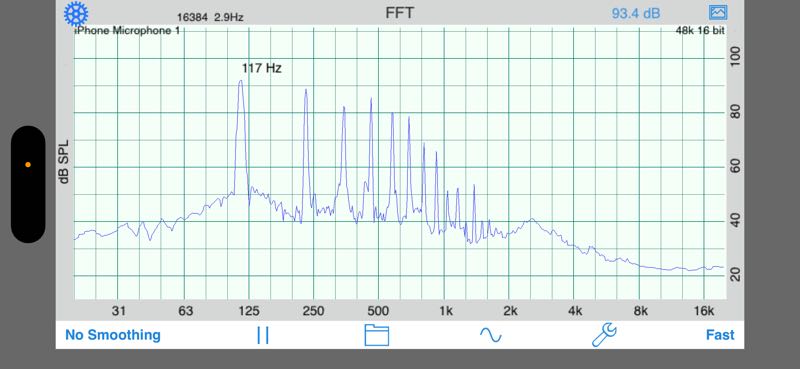
An oscilloscope is time-domain, and it won't be that easy to see the effect. But a spectrum analyzer in the frequency domain will show it clearly.
Here's an example from an app on my iphone that costs a lot less than even a cheap oscilloscope :)
Here’s a 117-Hz high Bb. Note the 117-Hz spacing of the overtones.
- IMG_1934-dsqz.jpeg (40.23 KiB) Viewed 2467 times
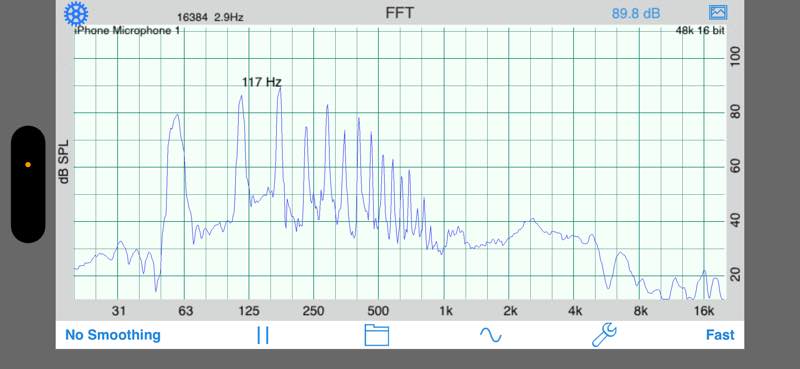
Here’s a 58-Hz low Bb. Note the 58-Hz spacing of the overtones, but also note that the low note is weaker in the fundamental with respect to the overtones.
- IMG_1930-dsqz.jpeg (35.39 KiB) Viewed 2467 times
The app is FFT by Studio Six Digital. The iPhone microphone is weak in the low end but the software is calibrated to that (and that’s why the hump for the fundamental is wide—it’s really cranked up and that also raises noise at those frequencies. Ignore everything below 40 dB--that's random ambient noise.
Rick "noting with surprise the lay people that can't tell the difference between my Holton and my B&S F tuba in my living room" Denney
Re: Air moving through the horn
Posted: Tue Jun 09, 2026 2:12 pm
by Rick Denney
thedancingsousa wrote: Mon Jun 08, 2026 12:21 pm
...
I'm aware of the existence of resultant tones, but Gail to see how that changes the fact that I can play the same note the same way in both a huge hall and a small room? I didn't have to open a door or anything to get the pitch to resonate. Obviously physics broke in that room, I guess. Or I'm some kind of genius. Doubtful to both.
Playing the note does not require any resonance in the outside room. It only requires resonance inside the instrument. The tube of a Bb tuba is 18 feet long (19.6 feet acoustically because of the taper and the bell effect), and only has to resonate half the wavelength to sustain the vibration. Its fundamental is therefore a 26-Hz pedal Bb, and the resonance to sustain that buzz happens entirely inside the instrument. The bell acts as an impedance matching device to keep the room air from bouncing all the sound back into the instrument, which is why ancient tubas with no bell flare and narrow throats can't be powerful in the bottom overtones.
The brain infers the pitch based on the overtone spacing, but the full roundness of the tone is difficult to perceive if the outer space doesn't propagate the sound with resonance. That's why it's difficult for lay people to tell the difference between small and large tubas performed in small spaces.
Not that resonance matters much in practice rooms anyway--they are usually acoustically damped to the point where they are dead, meaning nothing resonates in the room.
Rick "pedal Bb's are possible even in anechoic chambers with sufficiently low threshold frequencies, though none has ever been constructed because the traps have to be 20 feet deep" Denney
Re: Air moving through the horn
Posted: Tue Jun 09, 2026 7:02 pm
by bloke
an unscientific comment on your informative post @Rick Denney
Many many years ago, I had a studio record me playing a very large tuba in a very small studio with soundproofing and dampening.
Not only did the recording not sound like much of anything (other than a bunch of pitches played on a tuba) but the volume levels were pretty much negated by the engineers recording methods (combined with the size and style of the room in which I was recorded).
These guys seem to believe that optimally recording a tuba is going to be like recording an acoustic guitar, probably (??) because that's mostly what they record that is an acoustic instrument.
Re: Air moving through the horn
Posted: Wed Jun 10, 2026 7:04 am
by iiipopes
thedancingsousa wrote: Mon Jun 08, 2026 12:21 pm
iiipopes wrote: Mon Jun 08, 2026 10:51 am
thedancingsousa wrote: Mon Jun 08, 2026 6:19 am
Only thing I scoffed at was the idea that I couldn't play a pedal note in a small room. I laughed at that because it's a silly idea. Go off though!
Edit: To double check the audacity of my laughing at the idea of small rooms not containing pedal notes, I just closed myself in a room that's about 6'x8' and played F0. That note has a wavelength of just over 50ft. There is no dimension of the room I was in that would fit 50ft, yet I was able to play and hear the note. So, I will continue to laugh at that one idea as I have been.
You are not developing the true fundamental. You are hearing the overtones and the Helmholtz effect of that as set forth in his treatise, "On the Sensations of Tone," the psychoacoustic of the difference tones as the ear interprets them when overtones line up and reinforce the sensation of pitch. The tones are also known as difference tones or Tartini tones, as first observed in 1714 by Italian violinist Giuseppe Tartini. Please read the book and study Tartini's observations in their entirety before you make any more off-the-wall comments about how sound waves work.
I'm aware of the existence of resultant tones, but Gail to see how that changes the fact that I can play the same note the same way in both a huge hall and a small room? I didn't have to open a door or anything to get the pitch to resonate. Obviously physics broke in that room, I guess. Or I'm some kind of genius. Doubtful to both.
"Flat-Earther" may be a more accurate description.
Re: Air moving through the horn
Posted: Wed Jun 10, 2026 7:15 am
by thedancingsousa
If you're going to begin lumping me in with that crowd, I'm probably going to start ignoring you. Me pointing out that I can play a really low note in a tiny room without having to open up doors surely ruffled your feathers, I can see.
I went back and looked at that other thread and saw it was you who was claiming such things. To be clear, you can talk about how it doesn't resonate the same way or sounds the same as a smaller tuba or whatever you want. Go for it. In that other thread it certainly seemed like you were claiming it would be physically impossible to play such a note in a small room, pointing to your own experience of not being able to produce such notes on your own without increasing the size of space. That statement is just not objectively and universally true. I still find it ludicrous that you can believe such a thing, so I'm going to disengage from this conversation. Enjoy your life, friend.
Re: Air moving through the horn
Posted: Wed Jun 10, 2026 7:20 am
by bloke
I've got a really large and large bore tuba and a normal size and medium bore tuba that are both the same length, and I have yet another tuba that's much shorter and also medium size.
I can play a double low F on all three of them that's just below the range of the piano, but only after playing for a few minutes.
Otherwise - without playing for a few minutes first, I can only immediately play as low as the neighboring G flat.
I'm not sure what this means, but I'm also not particularly curious as to what it means.
That said, it's usually easier for me to play really low when there's more resistance. As an example, there's no way that I can produce these pitches with my lips without a tuba and a mouthpiece assisting me. Maybe (??), were it the case that I was playing the tuba in an old-fashioned phone booth - whereby the rubber gaskets on the door were fairly tight (and the only air coming in or going out was at the very bottom of the door) - that might somehow supply enough resistance against the very small amount of air coming out of the tuba to help me play really low pitches more easily. Do I know anything about this? No I do not.
Otherwise, I suspect my cat has a hairball and I probably need to take him to the vet this morning - even though I have a whole bunch of sousaphones to fix.
Re: Air moving through the horn
Posted: Wed Jun 10, 2026 8:20 am
by Rick Denney
bloke wrote: Wed Jun 10, 2026 7:20 am
I've got a really large and large bore tuba and a normal size and medium bore tuba that are both the same length, and I have yet another tuba that's much shorter and also medium size.
I can play a double low F on all three of them that's just below the range of the piano, but only after playing for a few minutes.
Otherwise - without playing for a few minutes first, I can only immediately play as low as the neighboring G flat.
I'm not sure what this means, but I'm also not particularly curious as to what it means.
That said, it's usually easier for me to play really low when there's more resistance. As an example, there's no way that I can produce these pitches with my lips without a tuba and a mouthpiece assisting me. Maybe (??), were it the case that I was playing the tuba in an old-fashioned phone booth - whereby the rubber gaskets on the door were fairly tight (and the only air coming in or going out was at the very bottom of the door) - that might somehow supply enough resistance against the very small amount of air coming out of the tuba to help me play really low pitches more easily. Do I know anything about this? No I do not.
Otherwise, I suspect my cat has a hairball and I probably need to take him to the vet this morning - even though I have a whole bunch of sousaphones to fix.
No, the phone booth won't help. The resistance in question happens where the tone resonates, which is inside the tuba. The bell, if it an efficient impedance matching device, will keep the room from influencing that resonance.
A small room will certainly affect how the tuba sounds when recorded, but I really do suspect that your experience with that was more about the compression of the recording system than it was about the resonance of the room. It is possible to record dynamics of tuba playing accurately, but tubas when played loud are very loud, especially close to the bell, and mic gain has to be turned right down to keep the microphone preamp in the mixer from either clipping or hitting the limiters (depending on the mixer). Mixers have a separate control for mic gain just for that purpose. Tuba sound can even bump into the maximum SPL capability of the microphone at times, which is unrecoverable.
But a small room will decrease the dynamics by adding all manner of room gain from all the reflected sound.
As to producing low frequencies in small spaces:
I am able to play (and barely hear, though the limitation is on human hearing, not on tone production) 20-Hz sine waves through my stereo loudspeakers. The full wavelength of that sound is 56 feet. If was exciting a column of air with a transducer (such as our lips) at one closed end, the tube only needs to be half that long. But even that is 28 feet. There is an interior dimension that long in my house, through an open door. But if we only heard what the room resonated, I'd be hearing it from that open doorway, not from the speaker itself, which when I did this was around a corner from that doorway. 20-Hz sound is difficult to localize, but that's part of the point. Even though the room doesn't resonate it, I can hear it from all directions.
Let's take that even further. I have headphones that will quite comfortably blast 40-Hz sound into my ear canal. The longest dimension in that space is about an inch.
Sound production does not require room resonance. Period. But room resonance can sure screw up (or enhance) the sound once it is produced. Sound propagation in a space benefits from room gain, and that requires non-resonant reflective surfaces, but it does not require room resonance. In fact, room resonance at specific frequencies leads to spikes in the room response curve, which will ring unrealistically, and sound people work to get rid of those resonances (the room can also cancel frequencies if the parallel reflective distances are one quarter of a wavelength, which creates a standing wave that nulls the sound at that frequency, a much more common problem.)
To create a sound wave, one only needs a transducer operating at the required frequency creating a succession of pressure peaks and nulls traveling through the air medium. Even without any reflections at all, such as in an anechoic chamber, that sound is audible. The transducer itself may not need resonance to create or amplify that sound. The electrical signals that move speaker cones have enough power behind them to make that speaker cone move no matter what the surrounding resonance. (How it does that does require an understanding of the driver resonances, but that's not the point.) But our lips do need reinforcement from the resonance of the instrument to sustain the buzz, unless the performer has the embouchure power to sustain the buzz frequency even without the resonance of the instrument. The purpose of the tuba is to amplify the harmonics and damp the non-harmonics, creating the characteristic tone. But we can free buzz the frequency without the tuba, and maybe even without the mouthpiece. That free buzz will not be amplified and all the non-harmonic noise will still be there, which is why it doesn't (yet) sound like a tuba. But producing the frequency does not formally require any resonance from the surrounding environment at all.
Rick "hoping the best for your cat" Denney