Help identifying a vintage Červený 4+1 rotary tuba (Opera or different model?)

Tubas, euphoniums, mouthpieces, and anything music-related.
Forum rules
This section is for posts that are directly related to performance, performers, or equipment. Social issues are allowed, as long as they are directly related to those categories. If you see a post that you cannot respond to with respect and courtesy, we ask that you do not respond at all.
Post Reply
User avatar
Mary
Posts: 12
Joined: Mon Jan 19, 2026 11:46 pm
Has thanked: 12 times
Been thanked: 3 times

Help identifying a vintage Červený 4+1 rotary tuba (Opera or different model?)

Post by Mary »

Hello everyone,

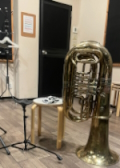
I would like to ask for your knowledge regarding this Cerveny tuba.

I recently won this instrument at an auction.
Based on its size and the 4+1 rotary valve configuration, it appears similar to the model often referred to as the OPERA (CBB-883-5Z).
However, when I compare it to the catalog specifications, the bell diameter and overall height seem slightly smaller.

Looking at the engraving, it appears to be from the 1970s.
The current OPERA model has a bell diameter of 40 cm, but this tuba’s bell measures 36 cm.
The bore is approximately 20 mm, so it seems to be clearly a 3/4-size instrument.

My question is:
Does anyone know whether this 4+1 rotary Cerveny tuba is actually an OPERA model, or perhaps a different (earlier) variant?

If anyone has old Cerveny catalogs, I would be very grateful if you could share or point me to them.
There used to be a OneDrive link with old catalogs posted on this forum, but unfortunately that link is no longer available.

Thank you very much for taking the time to read this,
and I appreciate any information you can share.
S__17580038_0.jpg
S__17580038_0.jpg (32.28 KiB) Viewed 701 times
Attachments
S__17580039_0.jpg
S__17580039_0.jpg (175.24 KiB) Viewed 701 times
S__17580036_0.jpg
S__17580036_0.jpg (69.49 KiB) Viewed 701 times
S__17580040.jpg
S__17580040.jpg (145.8 KiB) Viewed 701 times
These users thanked the author Mary for the post (total 2):
Mark E. Chachich (Sun Feb 01, 2026 12:12 pm) • gocsick (Sun Feb 01, 2026 3:07 pm)


User avatar
Mary
Posts: 12
Joined: Mon Jan 19, 2026 11:46 pm
Has thanked: 12 times
Been thanked: 3 times

Re: Help identifying a vintage Červený 4+1 rotary tuba (Opera or different model?)

Post by Mary »

My post has now been approved by the moderator.

I realize that while it was waiting for approval, the thread may have moved down the list.
If anyone happens to notice it and has any information, I would greatly appreciate your insight.

Thank you for your time
User avatar
ghmerrill
Posts: 46
Joined: Tue Dec 26, 2023 1:23 pm
Has thanked: 0
Been thanked: 19 times

Re: Help identifying a vintage Červený 4+1 rotary tuba (Opera or different model?)

Post by ghmerrill »

My AI speculates that it's a "Kaiserbass" (mostly on the basis of the 5th valve). It suggests the date as 1895-1908. It's assuming that it's a BBb horn, based on its appearance and the five valves. It also remarks that "The ornate geometric engraving + rolled garland is consistent with top-tier Kaiser models, not mid-range band tubas."

I'm not at all sure how reliable this assessment is, but it may be somewhere to start.

Hmmm ... I just updated my query with your dimensioned photo and the AI is fully in on it's being a

V. F. Červený & Syn
Kaiser-Bass (Kaiser-Tuba) in BB♭
5 rotary valves
ca. 1895–1905;;

It describes the horn as "a serious orchestral Kaiser, not a general band horn", and it remarks that period catalogs would not have a numbered model designation.
These users thanked the author ghmerrill for the post:
Mary (Thu Feb 05, 2026 3:47 pm)
Gary Merrill
Amati Oval Euph (DE 104, Euph J, J6 euph)
1924 Buescher 3-valve Eb tuba (with std US receiver), Kelly 25
Getzens 1052FD bass trombone, MK50 (nickel) lead pipe, DE LB K/K9/112 Lexan
Chris Mayer
Posts: 21
Joined: Fri Mar 08, 2024 8:55 am
Has thanked: 0
Been thanked: 13 times

Re: Help identifying a vintage Červený 4+1 rotary tuba (Opera or different modell?)

Post by Chris Mayer »

Dear Mary,

Congratulation for this nice instrument.

From an old Amati catalogue from the 1970-ies I have attached a picture of the #822 B Bass Opera from VF Cerneny. Looks very similar to your model. (body, bell ratio and postion, entry of mouthpiece into 5th valve etc).

Regarding dimensions, I would not be too much concerned about the instrument dimensions. Bell diameter and hight have changed with various models over time (Alexander 164: hight before WW 2 110 cm, 1975 108 cm, now 106 cm, Bell Alexander 163 42 cm now 45 cm,…). It is an Opera Model 822…..

Some thought on the tuba (and other can add):
From the picture of the bell and the „CSSR“ reference, the tuba is not older than 1960 as the name Československá socialistická republika, ČSSR for Czechoslovakia was introduced 1960. The engraving is also very artful which also indicates an older version. If you look closely at the picture from the 70-ties, the Cerveny logo is much less artful and complex. S shape valve linkage indicates also an older age as straight linkage/„minibal“ was introduced with some overlaps in the 70-ties. Hence presumably 60-65 years old.

If body and valves are tight and the linkage works nice, the tuba should be very nice, as a lot or all the components more or less are hand-made from sheet brass, bend in lead and hammered. Something very expensive or not existing anymore today and given such old tubas a special sound and color of sound. (ok modern techniques can be are more consistent….).

Have fun and leave it as original as possible (if some of the parts, valves etc are not fully crap).

Best
Christoph

PS: I have a Cerveny Catalogue Reprint from 1920-1930. There is nothing such an Opera like model listed in it. Opera seems to be a clear post WW2 development, maybe to address the often tight spaces in opera pits while providing a still powerful instrument. Therefore, I would not regard the Opera as a „3/4“ tuba (bore, diameter of bottoms bows)
Attachments
Cerveny Opera B Bass #822 (ca 1970k
IMG_1036.jpeg (119.29 KiB) Viewed 634 times
These users thanked the author Chris Mayer for the post (total 3):
Mark E. Chachich (Sun Feb 01, 2026 12:13 pm) • Thomas (Sun Feb 01, 2026 12:42 pm) • Mary (Thu Feb 05, 2026 3:47 pm)
User avatar
ghmerrill
Posts: 46
Joined: Tue Dec 26, 2023 1:23 pm
Has thanked: 0
Been thanked: 19 times

Re: Help identifying a vintage Červený 4+1 rotary tuba (Opera or different modell?)

Post by ghmerrill »

Chris Mayer wrote: Sun Feb 01, 2026 9:45 am From the picture of the bell and the „CSSR“ reference, the tuba is not older than 1960 as the name Československá socialistická republika, ČSSR for Czechoslovakia was introduced 1960.
Nice catch! The AI should have caught that (and I didn't look closely enough to notice it) -- but I use the lowest-end ChatGPT. :smilie6: Clockwork valve mechanisms were used for a LONG time. My 1965-ish Amati euph has them. I don't much like the feeling of them, but if the linkages haven't been abused and worn down, they should work just fine. (The ones on my euph were "rode hard and put up wet" -- and are quite clanky. When I have nothing else to do, I'll take the time to fix that. But I practically never play it.).
These users thanked the author ghmerrill for the post:
Mary (Thu Feb 05, 2026 3:47 pm)
Gary Merrill
Amati Oval Euph (DE 104, Euph J, J6 euph)
1924 Buescher 3-valve Eb tuba (with std US receiver), Kelly 25
Getzens 1052FD bass trombone, MK50 (nickel) lead pipe, DE LB K/K9/112 Lexan
User avatar
arpthark
Posts: 5771
Joined: Mon Aug 24, 2020 4:25 pm
Has thanked: 1773 times
Been thanked: 1912 times

Re: Help identifying a vintage Červený 4+1 rotary tuba (Opera or different model?)

Post by arpthark »

Late 1800s to early 1900s Bohemian rotary valves look a lot different than what’s posted.

I throw my vote behind 1960s Opera model BBb. I have a scan saved somewhere…
These users thanked the author arpthark for the post:
Mary (Thu Feb 05, 2026 3:47 pm)
User avatar
ghmerrill
Posts: 46
Joined: Tue Dec 26, 2023 1:23 pm
Has thanked: 0
Been thanked: 19 times

Re: Help identifying a vintage Červený 4+1 rotary tuba (Opera or different model?)

Post by ghmerrill »

arpthark wrote: Sun Feb 01, 2026 10:09 am Late 1800s to early 1900s Bohemian rotary valves look a lot different than what’s posted.
The 'S' linkages on this tuba are virtually identical to those on my 1965 Amati oval euph -- except mine has only a single "spur" at the midpoint of each, while this tuba has a spur on each side of the S link.
These users thanked the author ghmerrill for the post:
Mary (Thu Feb 05, 2026 3:47 pm)
Gary Merrill
Amati Oval Euph (DE 104, Euph J, J6 euph)
1924 Buescher 3-valve Eb tuba (with std US receiver), Kelly 25
Getzens 1052FD bass trombone, MK50 (nickel) lead pipe, DE LB K/K9/112 Lexan
User avatar
Mary
Posts: 12
Joined: Mon Jan 19, 2026 11:46 pm
Has thanked: 12 times
Been thanked: 3 times

Re: Help identifying a vintage Červený 4+1 rotary tuba (Opera or different model?)

Post by Mary »

ghmerrill wrote: Sun Feb 01, 2026 9:18 am My AI speculates that it's a "Kaiserbass" (mostly on the basis of the 5th valve). It suggests the date as 1895-1908. It's assuming that it's a BBb horn, based on its appearance and the five valves. It also remarks that "The ornate geometric engraving + rolled garland is consistent with top-tier Kaiser models, not mid-range band tubas."

I'm not at all sure how reliable this assessment is, but it may be somewhere to start.

Hmmm ... I just updated my query with your dimensioned photo and the AI is fully in on it's being a

V. F. Červený & Syn
Kaiser-Bass (Kaiser-Tuba) in BB♭
5 rotary valves
ca. 1895–1905;;

It describes the horn as "a serious orchestral Kaiser, not a general band horn", and it remarks that period catalogs would not have a numbered model designation.
Hello ghmerrill,

Thank you very much for your reply.
I also asked ChatGPT and Gemini, but they could only suggest a rather broad production range of around 1970–1990, so your historical perspective is very helpful.

The overall height of this tuba is only 85 cm, so it does not appear to be a Kaiser-size instrument.
It is still a bit of a mystery to me what exact model it is, but I have decided to enjoy and care for it as it is.

I noticed that you own an Amati oval euphonium.
I usually play an Amati 4-rotary tuba, probably from the 1990s.
I really admire the S-linkage on your euphonium — my tuba does not have S-linkage.

May I ask: do you think the more complex linkage and external mechanisms could indicate an earlier production period?
If so, perhaps a 1960s origin might also be possible.

Thank you again for sharing your knowledge.

Best regards,
Mary
User avatar
Mary
Posts: 12
Joined: Mon Jan 19, 2026 11:46 pm
Has thanked: 12 times
Been thanked: 3 times

Re: Help identifying a vintage Červený 4+1 rotary tuba (Opera or different modell?)

Post by Mary »

Chris Mayer wrote: Sun Feb 01, 2026 9:45 am Dear Mary,

Congratulation for this nice instrument.

From an old Amati catalogue from the 1970-ies I have attached a picture of the #822 B Bass Opera from VF Cerneny. Looks very similar to your model. (body, bell ratio and postion, entry of mouthpiece into 5th valve etc).

Regarding dimensions, I would not be too much concerned about the instrument dimensions. Bell diameter and hight have changed with various models over time (Alexander 164: hight before WW 2 110 cm, 1975 108 cm, now 106 cm, Bell Alexander 163 42 cm now 45 cm,…). It is an Opera Model 822…..

Some thought on the tuba (and other can add):
From the picture of the bell and the „CSSR“ reference, the tuba is not older than 1960 as the name Československá socialistická republika, ČSSR for Czechoslovakia was introduced 1960. The engraving is also very artful which also indicates an older version. If you look closely at the picture from the 70-ties, the Cerveny logo is much less artful and complex. S shape valve linkage indicates also an older age as straight linkage/„minibal“ was introduced with some overlaps in the 70-ties. Hence presumably 60-65 years old.

If body and valves are tight and the linkage works nice, the tuba should be very nice, as a lot or all the components more or less are hand-made from sheet brass, bend in lead and hammered. Something very expensive or not existing anymore today and given such old tubas a special sound and color of sound. (ok modern techniques can be are more consistent….).

Have fun and leave it as original as possible (if some of the parts, valves etc are not fully crap).

Best
Christoph

PS: I have a Cerveny Catalogue Reprint from 1920-1930. There is nothing such an Opera like model listed in it. Opera seems to be a clear post WW2 development, maybe to address the often tight spaces in opera pits while providing a still powerful instrument. Therefore, I would not regard the Opera as a „3/4“ tuba (bore, diameter of bottoms bows)
Hello Christoph,

Thank you very much for your reply.
I truly appreciate the detailed information you shared, and also your encouragement that the instrument’s size being outside current models is not a problem.

I originally purchased this tuba believing it was most likely an Opera model, but I began to feel uncertain about its background and history, which is why I decided to ask here.
Your explanation about when the “ČSSR” engraving began to be used, as well as sharing information from older catalogs, was extremely helpful.

It now seems quite possible that this instrument dates from the 1960s, and with that in mind, I would like to continue playing it as it is, without making modifications or cutting the instrument.

It will probably not be very welcome in a large wind band, so it seems this tuba will mainly be for my own personal playing — which is perfectly fine with me. 🙂

Thank you again for your kindness and knowledge.

Best regards,
Mary

P.S. Thank you as well for sharing your thoughts on the difference between a so-called 3/4 tuba and the Opera model.
I agree with you — this Opera seems to be complete and well-balanced at its intended size, rather than a reduced or compromised instrument.
I have reconsidered my view, and I will take good care of it.
User avatar
Mary
Posts: 12
Joined: Mon Jan 19, 2026 11:46 pm
Has thanked: 12 times
Been thanked: 3 times

Re: Help identifying a vintage Červený 4+1 rotary tuba (Opera or different model?)

Post by Mary »

arpthark wrote: Sun Feb 01, 2026 10:09 am Late 1800s to early 1900s Bohemian rotary valves look a lot different than what’s posted.

I throw my vote behind 1960s Opera model BBb. I have a scan saved somewhere…
Hello arpthark,

Thank you very much for your reply.
It is interesting to consider that this instrument could possibly date from around 1960. Since I do not have access to old catalogs, I feel very fortunate to be able to rely on the collective knowledge of the members of this forum.

Recently, I noticed a four-digit number in the 9000 range stamped near the lever area. However, I remember someone here once saying that “the only consistency of Cerveny is its inconsistency,” so I suspect this marking may not have any clear or meaningful significance.

If you happen to have photos, I would be very happy to see them — but please do not feel any obligation.
Thank you again for taking the time to reply.

Best regards,
Mary
User avatar
Mary
Posts: 12
Joined: Mon Jan 19, 2026 11:46 pm
Has thanked: 12 times
Been thanked: 3 times

Re: Help identifying a vintage Červený 4+1 rotary tuba (Opera or different modell?)

Post by Mary »

Chris Mayer wrote: Sun Feb 01, 2026 9:45 am Dear Mary,

Congratulation for this nice instrument.

From an old Amati catalogue from the 1970-ies I have attached a picture of the #822 B Bass Opera from VF Cerneny. Looks very similar to your model. (body, bell ratio and postion, entry of mouthpiece into 5th valve etc).

Regarding dimensions, I would not be too much concerned about the instrument dimensions. Bell diameter and hight have changed with various models over time (Alexander 164: hight before WW 2 110 cm, 1975 108 cm, now 106 cm, Bell Alexander 163 42 cm now 45 cm,…). It is an Opera Model 822…..

Some thought on the tuba (and other can add):
From the picture of the bell and the „CSSR“ reference, the tuba is not older than 1960 as the name Československá socialistická republika, ČSSR for Czechoslovakia was introduced 1960. The engraving is also very artful which also indicates an older version. If you look closely at the picture from the 70-ties, the Cerveny logo is much less artful and complex. S shape valve linkage indicates also an older age as straight linkage/„minibal“ was introduced with some overlaps in the 70-ties. Hence presumably 60-65 years old.

If body and valves are tight and the linkage works nice, the tuba should be very nice, as a lot or all the components more or less are hand-made from sheet brass, bend in lead and hammered. Something very expensive or not existing anymore today and given such old tubas a special sound and color of sound. (ok modern techniques can be are more consistent….).

Have fun and leave it as original as possible (if some of the parts, valves etc are not fully crap).

Best
Christoph

PS: I have a Cerveny Catalogue Reprint from 1920-1930. There is nothing such an Opera like model listed in it. Opera seems to be a clear post WW2 development, maybe to address the often tight spaces in opera pits while providing a still powerful instrument. Therefore, I would not regard the Opera as a „3/4“ tuba (bore, diameter of bottoms bows)
n fact, this instrument has a few mechanical issues.
There are some connections that have come loose, and the linkage does not move as smoothly as it should.
Since I am not fully confident about the correct maintenance and care for this type of mechanism, I plan to consult a professional repair technician for guidance.

I understand that modern instrument design and manufacturing have surpassed these older instruments in terms of accuracy and consistency.
I also understand that, in order to participate in an ensemble, precision is often valued more highly than romance.
Even so, I found myself unable to resist purchasing this instrument.

I also own a 1990s Amati 4-rotary tuba and a 1945 Ernst David helicon, and all of them are instruments that can be challenging in terms of pitch.
Still, I intend to care for them and enjoy playing them.
User avatar
ghmerrill
Posts: 46
Joined: Tue Dec 26, 2023 1:23 pm
Has thanked: 0
Been thanked: 19 times

Re: Help identifying a vintage Červený 4+1 rotary tuba (Opera or different model?)

Post by ghmerrill »

The more I look at the pictures of this horn and compare it to various Cervenys, the more I'm convinced that it is some early version of an Opera: the geometry, relative sizes and positions of the slides, and the mechanism for the 5th valve. I just can't find an image of one with those 'S' rods on it. But pretty much everything else matches.
These users thanked the author ghmerrill for the post (total 2):
arpthark (Thu Feb 05, 2026 1:57 pm) • Mary (Thu Feb 05, 2026 3:47 pm)
Gary Merrill
Amati Oval Euph (DE 104, Euph J, J6 euph)
1924 Buescher 3-valve Eb tuba (with std US receiver), Kelly 25
Getzens 1052FD bass trombone, MK50 (nickel) lead pipe, DE LB K/K9/112 Lexan
Chris Mayer
Posts: 21
Joined: Fri Mar 08, 2024 8:55 am
Has thanked: 0
Been thanked: 13 times

Re: Help identifying a vintage Červený 4+1 rotary tuba (Opera or different model?)

Post by Chris Mayer »

Mary,

thx for the reply and nice that you got a lot of feedback.

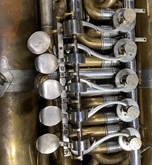
Don‘t worry. You have an Opera early 1960-ies. The S linkages and the valve rotors as pictured are THE very typical set-up of the Cerveny/Amati/Lignatone ones from this time. (my picture in my earlier post shows the later version of in-house version of uniball linkage). I have attached a picture of typical Amati/Cerveny/Lignatone valves for your information.

Another feature I have recognized is the adjustable spring tension of your paddles. Adjustment is done by turning the screws next to the spring casing (the cylinder to which the paddle is attached). This is very nice and kind of unique and indicating a higher value instrument (extra cost) and this feature is very rarely seen in later than lets say 1960-1970 instruments (see attached a picture of such a devise from an instrument made before WW2).

Last but not least. Please do not get blown away by that big orchestra / big tuba thing. Your tuba is not a toy and has the capability to support a larger group, purring like a cat in piano, or playing the scrap out of it if required. If you would be alone, then everybody is happy to have a decent tuba at all, if there is already other players, then the opera will nicely complement with its sound. (But this is another discussion).

Have fun with your nice instrument.

best
Chris
Attachments
Czech 1910-1920 spring tension adjustment
IMG_1098.jpeg (135.85 KiB) Viewed 408 times
Czech 1960-ties linkage
IMG_1095.png (137.75 KiB) Viewed 408 times
These users thanked the author Chris Mayer for the post:
Mary (Thu Feb 05, 2026 3:47 pm)
User avatar
Mary
Posts: 12
Joined: Mon Jan 19, 2026 11:46 pm
Has thanked: 12 times
Been thanked: 3 times

Re: Help identifying a vintage Červený 4+1 rotary tuba (Opera or different model?)

Post by Mary »

ghmerrill wrote: Thu Feb 05, 2026 1:54 pm The more I look at the pictures of this horn and compare it to various Cervenys, the more I'm convinced that it is some early version of an Opera: the geometry, relative sizes and positions of the slides, and the mechanism for the 5th valve. I just can't find an image of one with those 'S' rods on it. But pretty much everything else matches.
Hello ghmerrill,

Thank you again — I am truly grateful for the depth of knowledge shared by everyone on this forum.
It really may be an Opera after all.

One additional note: the fifth valve is currently stuck and does not move, similar to what is often seen on Piggy models.
I plan to take the instrument to a repair technician as soon as possible.

Thank you very much for your help.

Best regards,
Mary
User avatar
Mary
Posts: 12
Joined: Mon Jan 19, 2026 11:46 pm
Has thanked: 12 times
Been thanked: 3 times

Re: Help identifying a vintage Červený 4+1 rotary tuba (Opera or different model?)

Post by Mary »

Chris Mayer wrote: Thu Feb 05, 2026 3:35 pm Mary,

thx for the reply and nice that you got a lot of feedback.

Don‘t worry. You have an Opera early 1960-ies. The S linkages and the valve rotors as pictured are THE very typical set-up of the Cerveny/Amati/Lignatone ones from this time. (my picture in my earlier post shows the later version of in-house version of uniball linkage). I have attached a picture of typical Amati/Cerveny/Lignatone valves for your information.

Another feature I have recognized is the adjustable spring tension of your paddles. Adjustment is done by turning the screws next to the spring casing (the cylinder to which the paddle is attached). This is very nice and kind of unique and indicating a higher value instrument (extra cost) and this feature is very rarely seen in later than lets say 1960-1970 instruments (see attached a picture of such a devise from an instrument made before WW2).

Last but not least. Please do not get blown away by that big orchestra / big tuba thing. Your tuba is not a toy and has the capability to support a larger group, purring like a cat in piano, or playing the scrap out of it if required. If you would be alone, then everybody is happy to have a decent tuba at all, if there is already other players, then the opera will nicely complement with its sound. (But this is another discussion).

Have fun with your nice instrument.

best
Chris
Hello Christoph,

Thank you very much for your reply and for sharing the valuable photos.
Even without an original catalog, I am very happy that, with the help of the members of this forum, the identity of this instrument as a 1960s Opera has become much clearer.

Regarding the spring tension adjustment, I believe you are referring to this screw.
The auction seller explained that the first and second levers did not move because the springs were broken, so I was fully prepared to have them repaired.
However, after tightening the screws, the levers began to move — not perfectly, but functionally — which made me very happy.
A repair technician told me that these screws are intended to remove mechanical play, rather than to act as the springs themselves.

The fifth valve is still stuck, so I plan to have that repaired and then simply enjoy playing the instrument.

Thank you as well for helping to ease my concerns and insecurities about this instrument.
Modern tubas continue to become larger, with impressive designs, wider bells, and very stable intonation and range.
As someone who loves older German-style instruments, I sometimes felt that I might not be very welcome.
I will do my best to let the sound speak for itself.

Thank you again, sincerely.

Best regards,
Mary
Attachments
IMG_0079.jpeg
IMG_0079.jpeg (95.29 KiB) Viewed 393 times
Post Reply