What makes the sound?

Tubas, euphoniums, mouthpieces, and anything music-related.
Forum rules
This section is for posts that are directly related to performance, performers, or equipment. Social issues are allowed, as long as they are directly related to those categories. If you see a post that you cannot respond to with respect and courtesy, we ask that you do not respond at all.
donn
Posts: 1548
Joined: Mon Oct 26, 2020 2:31 pm
Location: Portugal
Has thanked: 12 times
Been thanked: 208 times

Re: What makes the sound?

Post by donn »

peterbas wrote: Wed Oct 30, 2024 3:05 pm
You should read up a little like here https://newt.phys.unsw.edu.au/jw/brassa ... .html#pipe
Thanks - a lot of interesting material there. Apologies for clipping this part, but I think it stands on its own without too much dependence on the rest of the material:
This simple picture already allows us to explain something about how the timbre changes when we go from playing softly to loudly. If we play softly, and especially if we play a high note softly, the lips don't move fast enough and don't have enough time to close completely. In this case we observe approximately sinusoidal vibrations: the system is behaving almost like the linear mass-and-spring oscillator of physics texts. This means that the fundamental in the sound spectrum is strong, but that the higher harmonics are weak. This gives rise to a mellow timbre. Playing loudly, the lips do close, and may close abruptly. This gives what physicists call clipping and strongly nonlinear behaviour, which produce more high harmonics. As well as making the timbre brighter, adding more harmonics makes the sound louder as well, because the higher harmonics fall in the frequency range where our hearing is most sensitive (See hearing curves for details).
I'll have to look harder at the closed pipe story, just guessing right now that they're saying a saxophone is "closed" but has its even partials because of the conical shape, and among wind instruments only the flute is "open." Oh well. My take is that the lips do not need to be completely closed for this effect - same reflection effect during the whole cycle because the embouchure is small enough.


donn
Posts: 1548
Joined: Mon Oct 26, 2020 2:31 pm
Location: Portugal
Has thanked: 12 times
Been thanked: 208 times

Re: What makes the sound?

Post by donn »

peterbas wrote: Thu Oct 31, 2024 4:20 am But the measurements and videos clearly show that the lips close completely so your take seems rather irrelevant, don't you think.
If you return to the same post you quoted, you'll see a discussion from the same source, about different playing regimes where the lips may or may not touch. Soft high notes vs. loud low notes, etc. "Playing loudly, the lips do close ..." -- but in either case the basic acoustic principle is the same.

So I'm sticking to my story: it's interesting, but it isn't a really fundamental point.
  • We have photos, we know that the lips close for the cases where we have the photos,
  • but whether they do or not in your mouthpiece when you're playing your music, we don't really know for sure, and we have no reason to believe in principle that they must, or they must not.
At most, it's about timbre. (I mean, it might depend on how loud you're playing, for example, but it's a side effect of that, and the timbre is the consequence.)
User avatar
bloke
Mid South Music
Posts: 24875
Joined: Thu Aug 13, 2020 8:55 am
Location: western Tennessee - near Memphis
Has thanked: 5274 times
Been thanked: 6035 times

Re: What makes the sound?

Post by bloke »

Who's trolling whom?

I don't know how many people stick out their jaw when they play. I don't. The opening between my lips is considerably more horizontal than it is vertical. If they drilled a hole in a mouthpiece and stuck a camera in there, I would wonder how the mouthpiece was clocked. Of course, the video is also super duper high resolution. :eyes:

Sometimes, when I have little bits dried skin on my lips - from not having played in a few days and/or having worked outside in the winter, my high range pitches (whereby the lips become much closer together, much more like an oboe reed or a trumpet embouchure) sound a little bit fuzzy (much as when moisture finds Its way between the two blades of oboe or bassoon reeds, and players immediately stop to clean that out) because those little bits of skin (or moisture bridging the individually-vibrating blades of those double reeds) are barely brushing against each other and disturbing the vibration. When I clean that dead skin off my lips, the disturbance in the vibration stops, because - once again - nothing is touching.

Sometimes when we fatigue ourselves - either from too many playing jobs or too much practicing or both, we end up with what we all refer to as a "double buzz". This occurs because one lip is vibrating half as fast as the other one. Again, it's due to fatigue or sometimes with younger players it's simply due to the lack of embouchure development. Were it that the lips were whacking against each other to make the sound, there could be no such thing as a double buzz, because it would be impossible for lips to hit each other at one speed yet also be hitting each other at another speed half as fast. Only with two lips individually vibrating at different speeds can this occur.
---------------
Is this similar to communist/libertarian sort of thing - much like those arguments between strangers on Facebook - where each believe they can convince the other that what they believe is right?

In a mouthpiece, I can't whack my lips against each other and make a viable sound. When I've heard first-day beginners try to do produce a sound with a brass instrument in the same way that they would otherwise make a "raspberries/fart" sound (with no mouthpiece or instrument), it sounds just like when I (video produced) try to quack my lips against each other inside a mouthpiece and play a brass instrument. It's nothing that anyone wants to hear, and it prevents the vibration of the lips. You ignore my video which actually supplies sound (which is the titled topic: producing sound) but you expect me to pay attention to another. You throw up charts and graphs and statistics in many threads, but never record yourself playing in order to demonstrate to us us how they are relevant.
Last edited by bloke on Thu Oct 31, 2024 7:43 am, edited 1 time in total.
User avatar
Mary Ann
Posts: 4262
Joined: Thu Aug 13, 2020 9:24 am
Has thanked: 816 times
Been thanked: 931 times

Re: What makes the sound?

Post by Mary Ann »

This us getting quite funny. I'm with Peterbas -- engineers, due to education and the fact that their mode of thinking drew them to that education, think in a certain way. I just wish I could find a physician who is capable of thinking that way.
User avatar
bloke
Mid South Music
Posts: 24875
Joined: Thu Aug 13, 2020 8:55 am
Location: western Tennessee - near Memphis
Has thanked: 5274 times
Been thanked: 6035 times

Re: What makes the sound?

Post by bloke »

non sequitur :eyes:

Once the engineer understands the mechanics, they're stop.
If they never understand them, they'll never stop.

The air column and the air pressure (via air restriction - a venturi) cause the lips to (individually) vibrate.

Jamming the lips together and making a fart sound into an input receptacle does not cause the air column to vibrate.
MiBrassFS
Posts: 1625
Joined: Thu Mar 28, 2024 8:25 am
Has thanked: 0
Been thanked: 631 times

Re: What makes the sound?

Post by MiBrassFS »

.
Last edited by MiBrassFS on Sat Jun 14, 2025 3:07 pm, edited 1 time in total.
User avatar
bloke
Mid South Music
Posts: 24875
Joined: Thu Aug 13, 2020 8:55 am
Location: western Tennessee - near Memphis
Has thanked: 5274 times
Been thanked: 6035 times

Re: What makes the sound?

Post by bloke »

MiBrassFS wrote: Thu Oct 31, 2024 11:56 am My upper lip and lower lip are different. How to they coordinate to vibrate together and not produce their own frequencies?

Anyone cares to is welcome and invited to give their opinion.
It is because the frequency at which they vibrate is caused by the length of the column of air and the amount of air pressure sent past the lips.

How often - do you suppose - that the two blades of an oboe or bassoon reed are absolutely identical?

Those who believe that the two blades of a bassoon reed (as stiff as they are, and with a c. 1/8th-inch space at their arc, and only about 1/2-inch wide) actually bang against each other...well, I can only smh. Those who believe that the steel vibrating reed of a jaw harp wouldn't vibrate were it not that it's attached to a steel frame (even though that frame is dampened by being bitten down against by upper and lower teeth, and these being the very same people)...well, I can only smh at that belief as well. Those who believe that strings (whereby the apex of their vibration can easily be seen far away from either ends of the strings) that the only reason they make a sound is because the ends of them (which are nearly stationary when the central portions of strings are vibrating wildly) set the bridge and nut (or felt) of a stringed instrument into motion...again: I can only smh. (strings: I'm not referring to the obviously acoustic amplification which occurs - typically due to large wood structures to which the holding ends of strings are attached, and only referring to the fact that the string itself is vibrating - with the ends only acting as supports designed to interfere with that vibration as little as possible).

Though straying off to a completely different topic, these may (??) be some of the same people who believe that the mass of a brass instrument mouthpiece contributes significantly to the timbre produced (though the overwhelming majority never had two identical-interior mouthpieces - more-mass/less-mass - to A/B, and to even make a completely non-scientific judgement call, with many fooling themselves by what they expect to hear, and - further - the overwhelming majority of higher-mass versions of mouthpieces ALSO being interior-altered in some way - typically: larger throat opening).

ie. "Every time I pee outside, the mailman comes by the very next day."
donn
Posts: 1548
Joined: Mon Oct 26, 2020 2:31 pm
Location: Portugal
Has thanked: 12 times
Been thanked: 208 times

Re: What makes the sound?

Post by donn »

bloke wrote: Thu Oct 31, 2024 12:20 pm Those who believe that the two blades of a bassoon reed (as stiff as they are, and with a c. 1/8th-inch space at their arc, and only about 1/2-inch wide) actually bang against each other...well, I can only smh.
Meanwhile we're smh about 1) that "bang against each other" story that thoroughly misrepresents what happens, and 2) the denial of photographic evidence.

As far as I can tell, everyone else is talking about wind instruments. If you really think strings, jaw harp etc. are going to shed some light on this, you've taken on a fairly big job if you hope for anyone to see it. Ironically, it's the (invalid) string instrument analogy that leads people to the mouthpiece material/weight gimmicks, in hopes of "resonance" etc. Which is important for soundboards.
peterbas wrote: Thu Oct 31, 2024 7:38 am Photos/videos are from people actually playing.
Sure, and they show what happens when those people played, when the photos were taken. This is tautological. I don't think it proves that all players on every brass instrument always look the same - especially when the article says they don't. Without photos of a tuba player, moderate volume, middle range note like lower half of the bass clef ... I can't guarantee that lips would close in that case. They likely do, sure, but there's no inherent reason they must.
User avatar
bloke
Mid South Music
Posts: 24875
Joined: Thu Aug 13, 2020 8:55 am
Location: western Tennessee - near Memphis
Has thanked: 5274 times
Been thanked: 6035 times

Re: What makes the sound?

Post by bloke »

This picture is even crappier than that lips movie...
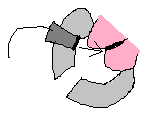
crappy pic.png
crappy pic.png (1.69 KiB) Viewed 6052 times
...but
- The movie is low resolution.
- It's not known where the mouthpiece was drilled to insert the tiny camera. The ideal angle would be just below center (as most trumpet players play "down-stream", but that spot would interfere with the throat).
- The higher the pitch, the tinier the space between the lips (just as with the epic difference between oboe double reed and bassoon double reed openings). With trumpet playing, the arc becomes - again - just about microscopic, and the blurry movie is anything-but at the microscopic level, and nor (from what I've seen) is it pointed straight on at the nearly-microscopic space between the lips...so there's really nothing to be seen that demonstrates anything for certain.
- As you (finally) admit that you "can't guarantee that lips would close in that case" (as I contend that closing them would stop the vibration), why would they necessarily close at higher frequencies - such as a tuba player "squealing" out pitches way up at the top of the treble clef staff and above?
Why would a higher frequency range necessarily create an allowance or an exception?

summary:
- crappy low-res micro-camera movie
- unknown filming angle (which could well not reveal the opening, due to where the hole is trilled and how the mouthpiece is "clocked")
- admission that lips could possibly vibrate without touching each other
- as lips (and oboe reed blades vs. bassoon reed blades) become infinitely closer to each other (as the frequency increases) they can certainly become closer-and-closer to each other, YET never actually touch (at the tinier-and-tinier spot where they continue to vibrate at higher and higher frequencies).

One of you just loves charts and graphs. Here's a graph showing an arc whereby the arc creeps infinitely closer to nothing, YET never reaches nothing:
(something I was shown in elementary school)

Image


Seriously, you two guys are pm-ing each other and coordinating your trolls, yes?

Also:
I've heard that people who deal in "engineering" and "science" stuff - who encounter others who disagree with their observations - often embrace a hobby of (regardless of what actually is - which isn't the point) attempting to demonstrate that those - who disagree with their findings - are foolish or stupid...(again: a whole bunch like the totalitarian/equal distribution/keynesian -vs- libertarian/free-market/hayekian arguments on social media). I'll READILY ADMIT that I am both foolish AND stupid, if that's what y'all are attempting to pull off. :thumbsup:
donn
Posts: 1548
Joined: Mon Oct 26, 2020 2:31 pm
Location: Portugal
Has thanked: 12 times
Been thanked: 208 times

Re: What makes the sound?

Post by donn »

bloke wrote: Thu Oct 31, 2024 1:47 pm - As you (finally) admit that you "can't guarantee that lips would close in that case" (as I contend that closing them would stop the vibration), why would they necessarily close at higher frequencies - such as a tuba player "squealing" out pitches way up at the top of the treble clef staff and above?
It's tedious to be interrogated by someone who doesn't seem to have read what I wrote. I have been at some pains to repeatedly point out that, as i understand it, whether the lips touch does not matter to the production of sound. I have several times on preceding pages of this thread presented quotes wherein the physics story is that the lips apparently do not touch in some playing situations. When is that? They say, with high notes, and they say why. You can go back and read it if that's interesting to you.

As you have defined the corner you back yourself into, it's entirely appropriate that you can define your way out of it by means of infinitesimal approximation. Where the rest of us see the bassoon reeds in contact, your faith allows you to know that even so there's that molecule layer of air in there. OK, suit yourself. The point is, it doesn't matter. The resonating air column will bring the closed reed back to fully open position, just the same way as it would if there were really that tiny space. When the player has a working balance of air flow vs. the air column, the tone generator vibrates with the air. Closing is neither essential, nor disruptive, it's just an effect of the particular tone generator.
User avatar
Stryk
Posts: 549
Joined: Thu Aug 13, 2020 8:51 am
Has thanked: 213 times
Been thanked: 122 times

Re: What makes the sound?

Post by Stryk »

Terry Stryker
Mirafone 186C, 186BBb, 184C, 186C clone
Gebr. Alexander New 163C, Vintage 163C, Vintage 163BBb
Amati 481C
Lyon & Healy 6/4
Kane Stealth tuba
A plethora of others....
donn
Posts: 1548
Joined: Mon Oct 26, 2020 2:31 pm
Location: Portugal
Has thanked: 12 times
Been thanked: 208 times

Re: What makes the sound?

Post by donn »

peterbas wrote: Thu Oct 31, 2024 2:56 pm
MiBrassFS wrote: Thu Oct 31, 2024 11:56 am My upper lip and lower lip are different. How to they coordinate to vibrate together and not produce their own frequencies?

Anyone cares to is welcome and invited to give their opinion.
The standing wave makes the air pressure in the mouthpiece positive and negative.
Both lips follow the change in pressure, what doesn't mean that one can be longer then the other.
Yes, it isn't like your lips produce frequencies the way a guitar string does, out of their own resonant properties. The air column is the resonating element, here. Lips play a role, but not that role, so it luckily doesn't matter that a lip really doesn't have any resonant property at all.

Here we could go back to where we started on this wacky journey years ago: what about when you buzz into the air, no tuba and no resonating air column for your lips to work with? But of course we're not going there. Who cares about that?
donn
Posts: 1548
Joined: Mon Oct 26, 2020 2:31 pm
Location: Portugal
Has thanked: 12 times
Been thanked: 208 times

Re: What makes the sound?

Post by donn »

peterbas wrote: Thu Oct 31, 2024 3:05 pm It isn't that because of some exceptions which will probably exist that you can dismiss the positive and negative pressure in the mouthpiece forcing the lips in and out and the fact that the efficiency of the standing wave being reflected is the highest when it hits a solid object and not one with a hole in it, that you can state no inherent reason with a high probability factor.
If I understand you ... I'm just going from the resource you posted, where 1) they believe that under some playing regimes the mouth doesn't actually close, and 2) they explicitly say
For a sound wave, the tiny aperture between the lips – which is on average a much smaller cross section than the bore of the instrument – is enough to cause a reflection approximately like that from a completely closed end.
I.e., a hole is enough like a solid object, if the hole is relatively small. If you think that's too sloppy, maybe you'd like to present a discussion of the acoustical closed pipe in terms of a regime where the solid object appears at only one point in the cycle, and during other parts of the cycle there's a hole. I don't know enough about it myself, to say whether that's sound - if the reflection effect happens to apply only at that bottom pressure.

[edit] You may obtain extra credit for a discussion of the same principle in the saxophone or clarinet, where I believe we agree that the reed doesn't always close. [/edit]
Last edited by donn on Thu Oct 31, 2024 3:25 pm, edited 1 time in total.
MiBrassFS
Posts: 1625
Joined: Thu Mar 28, 2024 8:25 am
Has thanked: 0
Been thanked: 631 times

Re: What makes the sound?

Post by MiBrassFS »

.
Last edited by MiBrassFS on Sat Jun 14, 2025 3:07 pm, edited 1 time in total.
User avatar
russiantuba
Posts: 848
Joined: Thu Aug 13, 2020 8:04 am
Location: Circleville, Ohio
Has thanked: 69 times
Been thanked: 339 times
Contact:

Re: What makes the sound?

Post by russiantuba »

I don’t think about my lips when I play or think about embouchure nor do I teach it. Then again, I’m rooted in Jacobs/Rocco pedagogy.

If everyone participating in this thread put the same amount of time spent in they spent on this thread into developing their sound, a few more people than the “Tuba God” might have a world class sound
These users thanked the author russiantuba for the post:
Stryk (Thu Oct 31, 2024 7:57 pm)
Dr. James M. Green
Lecturer in Music--Ohio Northern University
Adjunct Professor of Music--Ohio Christian University
Gronitz PF 125
Miraphone 1291CC
Miraphone Performing Artist
www.russiantuba.com
User avatar
bloke
Mid South Music
Posts: 24875
Joined: Thu Aug 13, 2020 8:55 am
Location: western Tennessee - near Memphis
Has thanked: 5274 times
Been thanked: 6035 times

Re: What makes the sound?

Post by bloke »

@MiBrassFS

You need to take some lessons, so you can tune up your double buzz.

Hey...
Did you notice that I trolled some more charts and graphs?
These users thanked the author bloke for the post:
Stryk (Thu Oct 31, 2024 7:57 pm)
MiBrassFS
Posts: 1625
Joined: Thu Mar 28, 2024 8:25 am
Has thanked: 0
Been thanked: 631 times

Re: What makes the sound?

Post by MiBrassFS »

.
Last edited by MiBrassFS on Sat Jun 14, 2025 3:07 pm, edited 1 time in total.
donn
Posts: 1548
Joined: Mon Oct 26, 2020 2:31 pm
Location: Portugal
Has thanked: 12 times
Been thanked: 208 times

Re: What makes the sound?

Post by donn »

I've been assuming he really meant that the buzzes are not the same pitch. Other than that, not much help here - I could surf the web, or just guess, but in this exhaustive discussion we haven't gotten around to the really key question of how the lips really do start and maintain an air column vibrating at a particular pitch. We've been referring to the embouchuire as a hole, but it's a little more complicated than that. If there musculature or tissue has some irregularities due to injury or something .... oops, I'm guessing.
MiBrassFS
Posts: 1625
Joined: Thu Mar 28, 2024 8:25 am
Has thanked: 0
Been thanked: 631 times

Re: What makes the sound?

Post by MiBrassFS »

.
Last edited by MiBrassFS on Sat Jun 14, 2025 3:05 pm, edited 1 time in total.
User avatar
russiantuba
Posts: 848
Joined: Thu Aug 13, 2020 8:04 am
Location: Circleville, Ohio
Has thanked: 69 times
Been thanked: 339 times
Contact:

Re: What makes the sound?

Post by russiantuba »

peterbas wrote: Fri Nov 01, 2024 2:47 am
russiantuba wrote: Thu Oct 31, 2024 6:01 pm I don’t think about my lips when I play or think about embouchure nor do I teach it. Then again, I’m rooted in Jacobs/Rocco pedagogy.

If everyone participating in this thread put the same amount of time spent in they spent on this thread into developing their sound, a few more people than the “Tuba God” might have a world class sound
Since most of us are doing this for a hobby, they don't have that much time to spend.
You don't get an engineering degree without spending ample time studying.
In fact, are line of work changes so rapidly we still need to spend a bunch of hours just to keep up.
We can't use equipment that is a hundred years old or do repair work old style.
And where do you think all the latest improvements came from...
You obviously don’t catch the joke. Guess the old days of these forums are dying. This was before my time but has been brought up over the years.

Since you are a hobbyist, I would say spending time making music would be beneficial than the over-analysis. But to each their own.

And I’ve been watching YouTube videos on ancient cultures and how modern science doesn’t explain some of their innovations and advancements and how we are looking at ancient civilizations to learn about engineering, medical, and other scientific advancements.

I just cooked part of my breakfast in a microwave that has had daily use since 1988, while for offices/classrooms, we have bought multiple newer microwaves. I don’t care about the latest advances, I would rather use this outdated microwave that works and lasts than the newest equipment that dies after 5 uses.
Dr. James M. Green
Lecturer in Music--Ohio Northern University
Adjunct Professor of Music--Ohio Christian University
Gronitz PF 125
Miraphone 1291CC
Miraphone Performing Artist
www.russiantuba.com
Post Reply