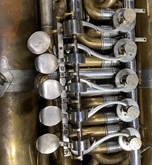
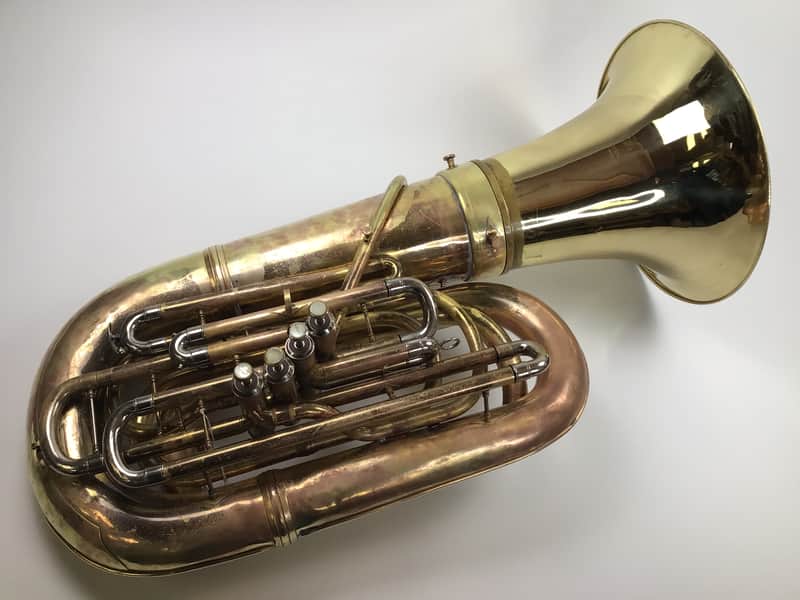
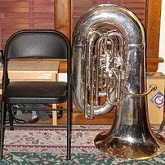
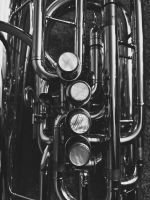
I've had this York Master (B&M) .750" bore 4-valve body for a while now and don't have anything particular in mind for it.
of course, German-made .750" bore 4-valve sets are somewhat sought-after by the frankentuba community.
Some may recall from previous posts that I have a 6/4 York BBb with three valves, with the pistons in somewhat worn condition (B-/C+ grade). That is a possibility, but it would take rerouting the 4th circuit completely based on the way it loops around the back of the cluster.
Here is an example image from Dillon's. Imagine this but with no bell:
I would try to find a one-piece bell for a Marzan. The interchangeable bell was, in my opinion, constrained by the bell ring to too small a diameter. The Marzan bell has a wider throat.
You might also check with Lee Stofer. He was working with Kanstul some years ago to make replacement upright bells for the YM. There’s a slight chance he still has one lying around.
The (Nirschl-made) B&M valves are indeed exceptional, and the 19mm tubing needed to reroute the fourth valve is easy to find. The open-wrap fourth valve is worth preserving, though, so you’d only want to change the connecting tubing. One issue is the angled arrangement, which doesn’t work for everyone. That was a minor annoyance for me. Beyond that, it would work great on a project to convert an upright 6/4 Bb carcass into a front-action tuba.
Rick “had to extend the 4th valve button, despite not being an outlier in terms of body size” Denney
These users thanked the author Rick Denney for the post:
dp wrote: Mon Apr 27, 2026 9:47 am
Can't route the 4th circuit outside where the third is now?
Sure can…
That routing really favors playability, although I get the aversion to the work, here's my 99 year old 692 with the stock "can't-reach-on-the-fly" 4th circuit routing
dp wrote: Tue Apr 28, 2026 8:03 am
That routing really favors playability, although I get the aversion to the work, here's my 99 year old 692 with the stock "can't-reach-on-the-fly" 4th circuit routing
I see an old bell scar -- was that originally a bell from a top action horn?
Though Klaus's York Master put the fourth slide next to the bell stack as did York, mine routed it to the backside of the instrument with a big wide-open loop. That feature is also present on my Hirsbrunner 193, and isn't worlds different from the back-side fourth-loop adjacent to a back-side third-branch slide as on B&S and Alexander tubas. That big loop is not only accessible, but minimizes the restriction of that long cylindrical branch. Fourth-valve notes on my York Master were without question one of its strong points--low F in particular was awesome.
Rick "a feature particularly praised by Chris Hall, who once owned it" Denney
These users thanked the author Rick Denney for the post (total 3):
If that upper 4th loop on the back we're made into a slide, it would actually be a more comfortably accessible 4th slide than way over to the players left on the front, would it not?
The other issue is with the pistons/casings being somewhat worn, how willing is someone to install a valve section like that to some frankintuba into which they put a minimum of 100 and possibly a maximum of 250 hours into building, and/or how willing would they be to pay one of these handful of people in the USA to rebuild them prior to installing them?
Eventually, I might have access to a whole bunch of Brazil four valve front action valve sets that are 18.5mm bore, but they are Brazil quality and were used for decades...
bloke wrote: Wed May 20, 2026 2:28 pm
If that upper 4th loop on the back we're made into a slide, it would actually be a more comfortably accessible 4th slide than way over to the players left on the front, would it not?
The other issue is with the pistons/casings being somewhat worn, how willing is someone to install a valve section like that to some frankintuba into which they put a minimum of 100 and possibly a maximum of 250 hours into building, and/or how willing would they be to pay one of these handful of people in the USA to rebuild them prior to installing them?...
Yes. The similar upper loop on the Hirsbrunner 193 is a slide, but on that tuba it doesn't need the lower loop at all.
The valves in mine were perfect, but they had been rebuilt by Wayne Tanabe (who had probably sent it to Anderson Plating). I would think any project that intended to produce a new-looking tuba would need to make sure the valves were like new.
Rick "can reach the fourth slide on a York-style instrument, but the fourth valve on the 726 was tucked into the space under the leadpipe, right?" Denney
If the tuba plays reasonably in tune with good intonation and response, leave it alone. If you have specific notes that are fuzzy, consider replacing the detachable bell with a fixed upright bell, as I did. (Search "Bessophone" on the forum for details.) The tenon and collar can damp antinodes and foul up intonation on specific notes.
The 186 that I converted had both bells, upright and detachable. The recording bell simply never performed as needed. First line Eb first valve would never center due to the interference with the antinode by the tenon and collar. I put a Besson 17-inch BBb bell on it, which much improved the horn. The bell tail was a little smaller in diameter, so it had to be trimmed to fit the Miraphone ferrule. To get it back down to pitch I lengthened the main tuning slide. This added just enough cylindrical tubing in the right place that by serendipity, the notorious flat fifth partials came up in pitch to tune as well so no alternate fingerings were needed. But that was individual to my horn.
Bottom line: if it ain't broke, don't "fix" it. If it is broke, do the least possible to get it playing well. If that doesn't work, then sky is the limit for modifications or transplants.
Last edited by iiipopes on Thu May 21, 2026 3:33 pm, edited 1 time in total.
I don’t know if you’re replying to my original post or someone else’s, @iiipopes, but it doesn’t have a bell, so it will definitely need to be “fixed” somewhat!
I’d put those valves on the York if they’re in better shape…
If I owned that York, I wouldn’t have sold you my B&M C, and instead pulled those valves off of it and stuck them on the York, after lengthening slides and re-routing some stuff, of course.
Sousaswag wrote: Fri May 22, 2026 2:08 pm
I’d put those valves on the York if they’re in better shape…
If I owned that York, I wouldn’t have sold you my B&M C, and instead pulled those valves off of it and stuck them on the York, after lengthening slides and re-routing some stuff, of course.
Yeah, the York 6/4 BBb is nice, but it's not going to win any beauty contests at this point, missing all the silver on the bottom bow guard and definitely has seen some heavy use -- not a "closet queen." Valves are a bit worn out and the 1st slide is just way too long. The York Master valves are actually in very nice shape. Point being, keeping the old York original is a nice idea, but there are other options. The YM valveset is one option, and another option is getting a 4+1 German-made valveset installed and having Anderson satin-silver plate the whole horn/valves. Gosh, that would be expensive, but you'd end up with a very nice, very large, very silver BBb tuba.
I have a couple options for bells lined up thanks to folks on this forum so I'll see what comes of all of it when it's all said and done.
If the first slide on the 6/4 sort of resembles King, I believe I would pursue trying to reconfigure it similar to the first slide on a BB flat Holton 345, rather than just shortening that lower slide area...
Ie. Eliminate it all together, if the upper slide is fairly long.
That could help a whole lot in tuning options, as it does with the 345.
Otherwise, such an instrument (assuming three piston front action) might be deserving of a fresh European 4-piston valve set transplant, assuming no previous body overhauls (whereby the holy crap has been buffed out of it - as sadly happened to the CSO 6/4 York).
As casually discussed, I'd like to take a look at it.
Swapping the YM valves onto the 6/4 York is pretty much plug and play as the YM was loosely modeled after the York 712, which uses the exact same valveset as @arpthark's 6/4 York (except his is 3v versus the 712's 4v).
Having done this with my late model (late 1940 that is) 3v 712, it is a super easy swap. I can send you close up pictures of what I did for the fourth valve tubing if you'd like.
Putting a European 4v block on would be more work as the valve orientation is more upright rather than diagonal. The knuckle for the leadpipe is different and the knuckle going out to the MTS would be closer to the bell. Not terrible, but the YM swap would be a ton easier.
These users thanked the author York-aholic for the post (total 2):
bloke (Sun May 24, 2026 5:20 pm) • arpthark (Tue May 26, 2026 6:46 am)
Some old Yorks, Martins, and perhaps a King rotary valved CC
I had a closer look at this YM body this past weekend. It mostly lives in a dedicated body case so it's not really out and visible in my workshop area. This was a surplus instrument from the University of Texas (actually, I think someone scavenged it from a dumpster in Austin, and then I bought it from them).
The pistons are in okay shape. They aren't sparklingly beautiful, but there are no worn spots. Something I forgot about was there is one hole/patch on the fourth valve tubing. I'd be tempted to take that off and just braze it shut.
So, maybe not the best candidate to graft on to a 100 year old York BBb...
Lots of staring and pontificating going on around here, lately!
I also have leads for two YM recording bells. I could always take the tenon of one and graft it on a donor bell similar to what Dillon's did in the first picture on this thread.